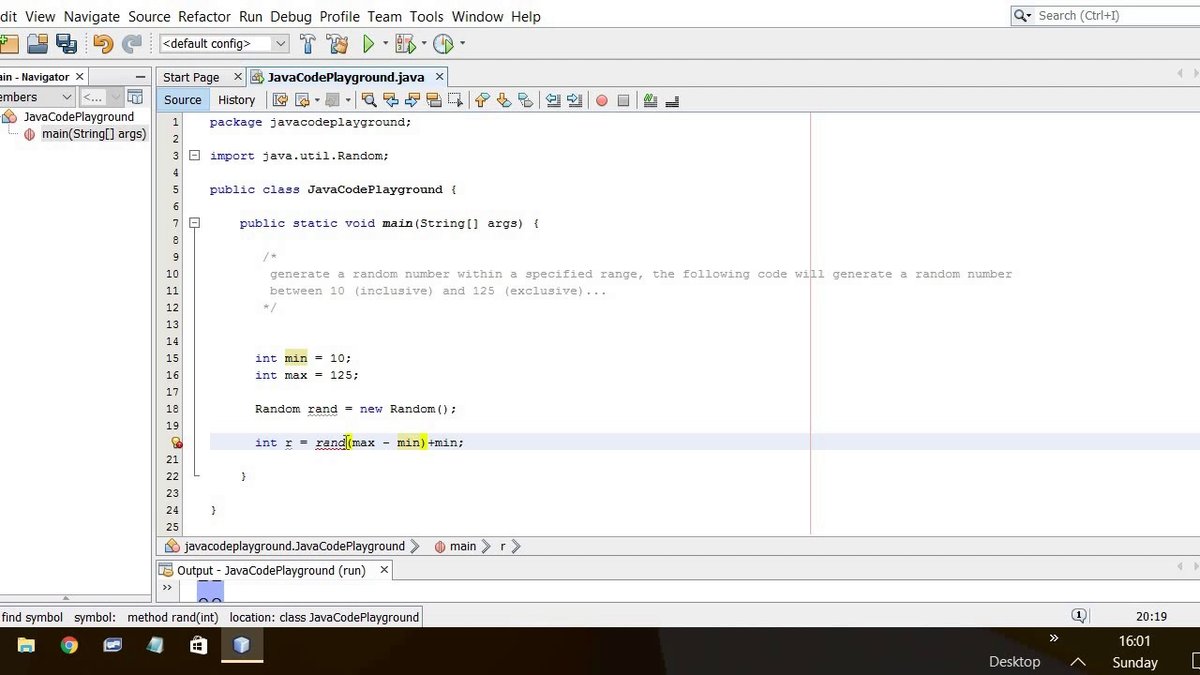
At its core, many sophisticated software systems, from secure financial transactions to immersive gaming worlds, rely on a seemingly simple yet profoundly powerful concept: random numbers. When you delve into the Basic Implementation of Java Random Number Generation, you're not just learning a trick; you're unlocking a fundamental building block for applications that need unpredictability, fairness, or a touch of chaos (the good kind). Java offers a spectrum of tools for this, each with a specific purpose, performance profile, and security guarantee. Choosing the right one is less about picking the "best" and more about selecting the "most appropriate" for the job at hand.
At a Glance: Your Quick Guide to Java's Random Number Tools
java.util.Random: Your general-purpose, non-cryptographic choice. Fast, but predictable if seeded. Best for simple, single-threaded tasks where security isn't a concern.java.security.SecureRandom: The heavyweight champion for security. Cryptographically strong, but slower and resource-intensive. Essential for anything involving sensitive data like keys or tokens.java.util.concurrent.ThreadLocalRandom: The speed demon for concurrent apps. Not cryptographically secure, but incredibly fast and efficient in multi-threaded environments.java.util.SplittableRandom: Perfect for parallel processing. Designed to be "split" into independent streams for high-performance, non-cryptographic tasks.Math.random(): A convenient shortcut that internally usesjava.util.Randomfor a quickdoublebetween 0.0 and 1.0.
Why Randomness Matters (More Than You Think)
Random number generation (RNG) isn't just for rolling dice in a game. It's the silent workhorse behind a surprising array of critical applications:
- Cryptography: Generating secure keys, nonces, and salts. Without truly random numbers, these become vulnerable.
- Game Mechanics: Spawning enemies, shuffling decks, determining critical hits, procedural content generation.
- Simulations: Modeling weather patterns, financial markets, scientific experiments, or agent-based systems where variability is key.
- Authentication & Security: Creating unique session IDs, password reset tokens, or one-time passcodes.
- Testing: Generating diverse input data to thoroughly test software.
The reliability and security of your application often hinge on the quality of its random numbers. A "bad" random number generator can introduce subtle biases, predictable patterns, or outright security vulnerabilities, making it crucial to understand the nuances of Java's offerings.
Deciphering Java's Core Random Number Generators
Let's break down the main players in Java's RNG ecosystem, understanding their strengths, weaknesses, and optimal use cases. Think of them as specialized tools in a workshop; you wouldn't use a sledgehammer to drive a thumbtack, nor would you use a jeweler's hammer to demolish a wall.
The Everyday Workhorse: java.util.Random
When most developers think of random numbers in Java, java.util.Random is likely the first class that comes to mind. It's Java's oldest and most straightforward random number generator, but its simplicity comes with important caveats.
- How it Works (Under the Hood):
Randomemploys a Linear Congruential Generator (LCG). This mathematical algorithm generates a sequence of numbers where each number is computed from the previous one using a linear equation. - Security Profile: It's a pseudo-random number generator (PRNG). This means the numbers it produces are not truly random but appear random. If you know the initial "seed" value, you can predict the entire sequence of numbers it will generate. This predictability makes it unsuitable for security-sensitive applications.
- Thread Safety:
java.util.Randomis thread-safe. Its methods are synchronized, meaning that multiple threads can callnextInt(),nextLong(), etc., without corrupting the internal state. However, this synchronization comes at a performance cost in highly concurrent environments, as threads might contend for the lock, leading to bottlenecks. - Performance: Generally quite fast for single-threaded operations, achieving around 50 million operations per second.
- Best For: Simple, non-security-sensitive applications. Think generating a random index for an array, picking a random item from a list, or creating simple game elements where predictability isn't a vulnerability.
- Core Methods:
nextInt(): Returns a randomintvalue.nextInt(int bound): Returns a randomintbetween 0 (inclusive) andbound(exclusive).nextLong(),nextFloat(),nextDouble(),nextBoolean(),nextGaussian(): For other primitive types and a Gaussian (normal) distribution.
Basic Random Implementation Example
java
import java.util.Random;
public class BasicRandomExample {
public static void main(String[] args) {
// 1. Instantiate a Random object
Random random = new Random(); // Uses current time as default seed
System.out.println("--- Using java.util.Random ---");
// 2. Generate a random integer
int randomNumber = random.nextInt();
System.out.println("Random integer: " + randomNumber);
// 3. Generate a random integer within a specific bound (0 to 99)
int randomBoundedNumber = random.nextInt(100); // 0 (inclusive) to 100 (exclusive)
System.out.println("Random integer (0-99): " + randomBoundedNumber);
// 4. Generate a random double (0.0 to 1.0)
double randomDouble = random.nextDouble();
System.out.println("Random double (0.0-1.0): " + randomDouble);
// 5. Explicitly seeding for reproducible sequences (useful for testing)
Random seededRandom = new Random(12345L); // Same seed, same sequence
System.out.println("\n--- Using a seeded Random ---");
System.out.println("First from seeded: " + seededRandom.nextInt(100));
System.out.println("Second from seeded: " + seededRandom.nextInt(100));
// If you run this again with the same seed, you'll get the same numbers.
}
}
Quick Note on Seeding: While new Random() uses the current time as a seed, leading to different sequences each time you run the program, explicitly providing a seed (new Random(someValue)) ensures the sequence is reproducible. This is invaluable for testing, but a critical security flaw if used in production for sensitive data.
The Security Guardian: java.security.SecureRandom
When you absolutely, positively cannot compromise on randomness for security, java.security.SecureRandom is your go-to. This class is designed for cryptographic strength.
- How it Works (Under the Hood):
SecureRandomleverages cryptographically strong pseudo-random number generators (CSPRNGs). These algorithms are much more sophisticated than LCGs, making it computationally infeasible to predict future output even if past outputs are known. It often draws "entropy" (true randomness) from system-level sources like/dev/randomor/dev/urandomon Unix-like systems, or the operating system's native RNG on Windows. - Security Profile: Cryptographically secure. This is the crucial distinction. Use it for generating session IDs, password salts, cryptographic keys, nonces, and other security-sensitive data.
- Thread Safety:
SecureRandomis thread-safe. UnlikeRandom, its internal mechanisms are designed to handle concurrent access efficiently without significant performance degradation due to synchronization contention. - Performance: Significantly slower than
RandomorThreadLocalRandom, often around 1 million operations per second. This is because it does more work to ensure cryptographic strength and may involve blocking to gather sufficient entropy. - Memory Footprint: Can be higher due to the complex state it maintains and potential entropy buffers.
- Best For: Any application requiring high-quality, unpredictable random numbers for security purposes.
- Core Methods:
nextBytes(byte[] bytes): Fills the specified byte array with cryptographically strong random bytes. Often used for key material or tokens.nextInt(int bound): Returns a randomintwithin the specified bound.getInstance(String algorithm): Allows specifying a particular algorithm (e.g., "SHA1PRNG", "NativePRNG").
Implementing SecureRandom for Robust Security
java
import java.security.SecureRandom;
import java.util.Base64;
public class SecureRandomExample {
public static void main(String[] args) {
// 1. Instantiate a SecureRandom object
SecureRandom secureRandom = new SecureRandom(); // Uses default strong algorithm
System.out.println("--- Using java.security.SecureRandom ---");
// 2. Generate a cryptographically strong session ID (e.g., 32 bytes)
byte[] sessionIDBytes = new byte[32];
secureRandom.nextBytes(sessionIDBytes);
String sessionID = Base64.getUrlEncoder().withoutPadding().encodeToString(sessionIDBytes);
System.out.println("Secure Session ID: " + sessionID);
// 3. Generate a strong password salt (e.g., 16 bytes)
byte[] saltBytes = new byte[16];
secureRandom.nextBytes(saltBytes);
String salt = Base64.getUrlEncoder().withoutPadding().encodeToString(saltBytes);
System.out.println("Secure Password Salt: " + salt);
// 4. Generate a random integer (use with caution, nextBytes is preferred for security)
int secureInt = secureRandom.nextInt(1000); // For non-security int needs
System.out.println("Secure random integer (0-999): " + secureInt);
// Advanced: Specifying an algorithm (optional, defaults are usually good)
try {
SecureRandom sha1PRNG = SecureRandom.getInstance("SHA1PRNG");
byte[] keyBytes = new byte[64];
sha1PRNG.nextBytes(keyBytes);
System.out.println("\nSecure key (SHA1PRNG): " + Base64.getUrlEncoder().withoutPadding().encodeToString(keyBytes).substring(0, 20) + "...");
} catch (java.security.NoSuchAlgorithmException e) {
System.err.println("Algorithm not found: " + e.getMessage());
}
}
}
Entropy Considerations: The initial seeding of SecureRandom can sometimes be slow, especially on systems with low "entropy" (not enough truly random events like mouse movements or network activity). In high-throughput server environments, this startup cost is typically paid once. For extreme cases, you might configure JVM arguments like -Djava.security.egd=file:/dev/./urandom to point to a faster (but potentially less "random") entropy source like /dev/urandom on Linux, assuming your security model allows it.
The Concurrent Champion: java.util.concurrent.ThreadLocalRandom
For modern multi-threaded Java applications demanding high-performance random number generation, ThreadLocalRandom is often the optimal choice. It was introduced in Java 7 as part of the java.util.concurrent package.
- How it Works (Under the Hood): Instead of a single shared
Randominstance with synchronization overhead,ThreadLocalRandomprovides a separate, independentRandominstance for each thread. This eliminates contention and synchronization completely. - Security Profile: Like
Random, it's a pseudo-random number generator and not cryptographically secure. Do not use it for security-sensitive operations. - Thread Safety: It's inherently thread-local, meaning each thread gets its own isolated generator. There's no shared state, so no synchronization is needed, making it extremely efficient in concurrent scenarios.
- Performance: Blazingly fast, often achieving 200 million operations per second or more. This makes it the fastest option for non-cryptographic random number generation in multi-threaded environments.
- Memory Footprint: Medium, as each thread maintains its own small
Randomstate. - Best For: High-performance, multi-threaded applications where many threads simultaneously need non-cryptographic random numbers. Examples include simulations, concurrent game logic, or load balancing algorithms.
- Access Pattern: You don't instantiate
ThreadLocalRandomdirectly withnew. Instead, you retrieve the current thread's instance usingThreadLocalRandom.current(). - Core Methods: Similar to
Random, withnextInt(),nextInt(bound),nextLong(),nextDouble(), etc. It also offersnextInt(int origin, int bound)for a more convenient range specification.
ThreadLocalRandom in Action
java
import java.util.concurrent.ThreadLocalRandom;
import java.util.concurrent.ExecutorService;
import java.util.concurrent.Executors;
import java.util.concurrent.TimeUnit;
public class ThreadLocalRandomExample {
public static void main(String[] args) throws InterruptedException {
System.out.println("--- Using java.util.concurrent.ThreadLocalRandom ---");
// Example 1: Simple usage in the main thread
int randomValue = ThreadLocalRandom.current().nextInt(1, 101); // 1 (inclusive) to 101 (exclusive)
System.out.println("Random number (1-100) from main thread: " + randomValue);
// Example 2: Usage in a multi-threaded context
int numThreads = 5;
ExecutorService executor = Executors.newFixedThreadPool(numThreads);
for (int i = 0; i < numThreads; i++) {
final int threadId = i;
executor.submit(() -> {
// Each thread gets its own ThreadLocalRandom instance
int localRandom = ThreadLocalRandom.current().nextInt(100, 201); // 100 to 200
System.out.println("Thread " + threadId + " generated: " + localRandom);
});
}
executor.shutdown();
executor.awaitTermination(1, TimeUnit.MINUTES);
System.out.println("All threads finished.");
}
}
Notice how ThreadLocalRandom.current() is called within each thread's task. This ensures that each thread operates on its own random number generator state, preventing any performance bottlenecks from shared resources. This makes it a fantastic choice for scenarios like weighted random selection in load balancing, where multiple concurrent requests need quick, independent random decisions.
The Parallel Processor: java.util.SplittableRandom
SplittableRandom, introduced in Java 8, is another pseudo-random generator, specifically designed for parallel computations. It's unique in its ability to efficiently generate new independent SplittableRandom instances from an existing one, making it ideal for fork-join frameworks and parallel streams.
- How it Works: It uses a different algorithm that allows for "splitting." When you call
split()on aSplittableRandominstance, it creates a new instance that is statistically independent of the original and shares no mutable state. This avoids the need for synchronization orThreadLocalstorage in many parallel contexts. - Security Profile: Not cryptographically secure. Like
RandomandThreadLocalRandom, it's a PRNG. - Thread Safety: Not thread-safe. A single
SplittableRandominstance should not be shared across multiple threads. Its strength lies in being split into new, independent instances for parallel tasks. - Best For: Parallel algorithms where you need to distribute random number generation work across multiple threads or tasks, such as Monte Carlo simulations, genetic algorithms, or other embarrassingly parallel computations.
- Core Methods:
split(): Returns a newSplittableRandominstance that is statistically independent.nextLong(),nextInt(),nextDouble(), etc.: Standard generation methods.
A Glimpse at SplittableRandom
java
import java.util.SplittableRandom;
import java.util.stream.IntStream;
public class SplittableRandomExample {
public static void main(String[] args) {
System.out.println("--- Using java.util.SplittableRandom ---");
SplittableRandom sr = new SplittableRandom();
System.out.println("Original SR first int: " + sr.nextInt(100));
// Create a new independent SR from the original
SplittableRandom sr2 = sr.split();
System.out.println("Split SR first int: " + sr2.nextInt(100));
System.out.println("Original SR second int: " + sr.nextInt(100)); // Still distinct
// Useful for parallel streams
long sum = IntStream.range(0, 10)
.parallel() // Process in parallel
.mapToObj(i -> new SplittableRandom()) // Each parallel task gets its own SR
.mapToInt(s -> s.nextInt(1, 101)) // Generate a random number
.peek(randNum -> System.out.println(Thread.currentThread().getName() + " generated: " + randNum))
.sum();
System.out.println("Sum of 10 parallel random numbers: " + sum);
}
}
While not as commonly encountered in basic implementations, understanding SplittableRandom is key for advanced performance optimizations in parallel computing.
The Quick double: Math.random()
Math.random() is often the first way beginners learn to get a random number in Java, primarily because it's so easy to use.
- What it Does: Returns a
doublevalue with a positive sign, greater than or equal to0.0and less than1.0. - How it Works (Under the Hood):
Math.random()is a static helper method. On its first call, it secretly creates and initializes a singlenew java.util.Random()instance. All subsequent calls use this same hiddenRandominstance. - Thread Safety: Since it uses a
java.util.Randominstance internally, it inherits the synchronization and thread-safe characteristics ofRandom. This means it will suffer from contention in multi-threaded environments, just likeRandom. - Security Profile: Not cryptographically secure. Because it relies on
java.util.Random, it's subject to the same predictability concerns. - Best For: Quick, non-critical needs for a random floating-point number between 0 and 1, usually in single-threaded contexts or where performance is not paramount.
Math.random() in Brief
java
public class MathRandomExample {
public static void main(String[] args) {
System.out.println("--- Using Math.random() ---");
// Generate a random double between 0.0 (inclusive) and 1.0 (exclusive)
double randomDouble = Math.random();
System.out.println("Random double from Math.random(): " + randomDouble);
// To get an integer within a range (e.g., 1 to 100):
int randomInt = (int) (Math.random() * 100) + 1; // 1 to 100
System.out.println("Random integer (1-100) using Math.random(): " + randomInt);
}
}
While convenient, generally prefer explicit Random or ThreadLocalRandom instances for more control and clarity, especially when you need integers or other types, or when performance in concurrent systems is a consideration.
Choosing the Right Tool: A Decision Framework
With several options at your disposal, how do you decide which Java random number generator to use? It boils down to a few key questions:
- Is security paramount?
- YES (e.g., passwords, keys, tokens, session IDs): Absolutely use
java.security.SecureRandom. There's no compromise here. - NO (e.g., game scores, UI randomness, non-sensitive simulations): Proceed to the next question.
- Is this a multi-threaded/concurrent application?
- YES (and security isn't an issue): Use
java.util.concurrent.ThreadLocalRandomfor optimal performance and efficiency. - NO (single-threaded, or minimal concurrency):
java.util.RandomorMath.random()are acceptable. If parallel processing is specifically involved (e.g., forStream.parallel()), considerSplittableRandom.
- Do I just need a quick
doublebetween 0 and 1?
Math.random()is convenient for this specific case, but remember it usesjava.util.Randomunder the hood, so its thread-safety and performance characteristics are the same. For more control, just usenew Random().nextDouble().
A Quick Comparison Table
| Feature | java.util.Random | java.security.SecureRandom | java.util.concurrent.ThreadLocalRandom | java.util.SplittableRandom | Math.random() |
|---|---|---|---|---|---|
| Algorithm | LCG | CSPRNG (e.g., SHA1PRNG) | PRNG (thread-local variant) | PRNG (for splitting) | LCG (via internal Random) |
| Security | Pseudo-random | Cryptographically Secure | Pseudo-random | Pseudo-random | Pseudo-random |
| Thread Safety | Synchronized (slow for many) | Thread-safe (built-in) | Thread-local (fastest for many) | Not thread-safe (designed to split) | Synchronized (via internal Random) |
| Performance | ~50M ops/sec | ~1M ops/sec (slower) | ~200M ops/sec (fastest) | Very fast for parallel splitting | ~50M ops/sec |
| Memory | Low | High | Medium (per thread) | Low | Low |
| Best Use Case | Simple, non-security, single-thread | Security-sensitive operations | High-perf concurrent, non-security | Parallel computations | Quick double (0.0-1.0) |
| Instantiation | new Random() | new SecureRandom() | ThreadLocalRandom.current() | new SplittableRandom() | Static method |
Real-World Scenarios and Practical Implementations
Let's ground this with a few common development tasks.
1. Generating a Secure Session ID or API Key
The Problem: You need to create a unique, unpredictable identifier for a user's session or an API key, where guessing or predicting the ID would be a major security flaw.
The Solution: java.security.SecureRandom.
java
import java.security.SecureRandom;
import java.util.Base64;
public class SecurityTokenGenerator {
private static final SecureRandom secureRandom = new SecureRandom(); // Reuse the instance
private static final Base64.Encoder base64Encoder = Base64.getUrlEncoder().withoutPadding();
public static String generateNewToken(int byteLength) {
byte[] randomBytes = new byte[byteLength];
secureRandom.nextBytes(randomBytes); // Fill array with random bytes
return base64Encoder.encodeToString(randomBytes); // Encode to a URL-safe string
}
public static void main(String[] args) {
System.out.println("Generated Session ID: " + generateNewToken(32)); // 32 bytes = 43 chars Base64
System.out.println("Generated API Key: " + generateNewToken(64)); // 64 bytes = 86 chars Base64
}
}
By reusing a single SecureRandom instance and generating sufficiently long random byte sequences, you ensure high entropy and strong cryptographic security.
2. Weighted Random Selection for Load Balancing
The Problem: You have multiple servers, and you want to distribute incoming requests among them, but not equally. Some servers are stronger or less busy and should receive more traffic. You need to pick a server randomly, but with weights.
The Solution: java.util.concurrent.ThreadLocalRandom (in a multi-threaded web server environment).
java
import java.util.concurrent.ThreadLocalRandom;
class Server {
String name;
int weight; // Higher weight means more requests
public Server(String name, int weight) {
this.name = name;
this.weight = weight;
}
@Override
public String toString() {
return name;
}
}
public class WeightedLoadBalancer {
public static Server chooseServer(Server[] servers) {
int totalWeight = 0;
for (Server s : servers) {
totalWeight += s.weight;
}
// Generate a random number between 0 (inclusive) and totalWeight (exclusive)
int randomNumber = ThreadLocalRandom.current().nextInt(totalWeight);
// Iterate and find the server corresponding to the random number
for (Server s : servers) {
if (randomNumber < s.weight) {
return s;
}
randomNumber -= s.weight;
}
// Should not happen if totalWeight is calculated correctly
return null;
}
public static void main(String[] args) {
Server[] servers = {
new Server("Web-A", 5), // 50% chance
new Server("Web-B", 3), // 30% chance
new Server("Web-C", 2) // 20% chance
};
System.out.println("--- Weighted Server Selection ---");
for (int i = 0; i < 10; i++) {
System.out.println("Request " + (i + 1) + ": Chosen Server = " + chooseServer(servers));
}
// In a real web server, 'chooseServer' would be called by different request-handling threads.
}
}
Using ThreadLocalRandom.current() ensures that each incoming request (handled by a different thread) gets its own, fast, non-contending random number generator for efficient server selection. This approach is highly performant. For a more comprehensive understanding of these concepts, consider exploring a broader Java random number generator guide.
3. A/B Testing User Assignment
The Problem: You want to assign users randomly to different test groups (A or B) to evaluate a new feature. The assignment needs to be consistent for a given user and roughly evenly distributed.
The Solution: A combination of user ID hashing (for consistency) and ThreadLocalRandom or Random (for initial assignment logic).
java
import java.util.concurrent.ThreadLocalRandom;
public class ABTester {
public enum Variant { A, B }
// This method could be part of a service that assigns a user to an A/B test variant
public static Variant assignUserToVariant(String userId) {
// Use user ID hash for consistency, ensuring same user always gets same result
// For simplicity, we'll use a basic hash code, but in real-world, a cryptographic hash is better.
int hash = userId.hashCode();
// Use a ThreadLocalRandom for the random assignment logic
// We'll normalize the hash to a positive value and use it as a pseudo-seed or part of a range decision
int randomFactor = ThreadLocalRandom.current().nextInt(0, 100); // 0-99
// Combine hash and random factor for a decision, e.g., 50/50 split
// For actual A/B tests, you often use the hash directly and modulo it
// e.g., if (Math.abs(hash) % 100 < 50) for 50% split.
// For demonstration, let's use a random choice here:
if (randomFactor < 50) { // 50% chance for A
return Variant.A;
} else { // 50% chance for B
return Variant.B;
}
}
public static void main(String[] args) {
System.out.println("--- A/B Testing User Assignment ---");
System.out.println("User 'user123' assigned to: " + assignUserToVariant("user123"));
System.out.println("User 'user456' assigned to: " + assignUserToVariant("user456"));
System.out.println("User 'user123' again assigned to: " + assignUserToVariant("user123")); // This demonstrates random assignment, not hash consistency.
// For strict hash consistency, you'd solely rely on the hash % X logic, without ThreadLocalRandom in the decision.
// Here, it's illustrative of a situation where a random choice is made for the user.
// A more typical A/B test assignment using only user ID for consistency:
System.out.println("\n--- A/B Testing (Consistent by User ID) ---");
System.out.println("User 'user123' consistently to: " + (Math.abs("user123".hashCode()) % 100 < 50 ? Variant.A : Variant.B));
System.out.println("User 'user456' consistently to: " + (Math.abs("user456".hashCode()) % 100 < 50 ? Variant.A : Variant.B));
System.out.println("User 'user123' consistently to: " + (Math.abs("user123".hashCode()) % 100 < 50 ? Variant.A : Variant.B));
}
}
Important Note: For strict A/B test consistency (where the same user always sees the same variant), you typically rely solely on a deterministic hash of the user ID (e.g., userId.hashCode() % 100). ThreadLocalRandom would be used if the assignment itself needed to be truly random at the moment of assignment, rather than consistently derived from the user ID.
Best Practices and Common Pitfalls
Even with the right tool, misuse can lead to problems. Here's how to keep your random number generation robust.
Do's
- Reuse
RandomandSecureRandomInstances:
- Creating new
RandomorSecureRandominstances repeatedly, especially in a tight loop, is inefficient and can lead to less random or predictable sequences if instantiated too close in time (especially forRandomusing default time-based seeds). - Instantiate them once (e.g., as a
static finalfield or a dependency-injected singleton) and reuse them. - For
SecureRandomin high-throughput environments, consider aRandomPoolto pre-initialize instances and reduce contention during startup.
- Use
ThreadLocalRandomfor Concurrent Applications:
- It's designed for this. Avoid
Randomin multi-threaded code unless you fully understand and accept the synchronization overhead.
- Always Use
SecureRandomfor Security:
- This cannot be overstated. Passwords, tokens, cryptographic keys, and anything that could expose users or data if predicted must use
SecureRandom.
- Understand Inclusive/Exclusive Bounds:
- Methods like
nextInt(int bound)generate numbers from 0 (inclusive) up tobound(exclusive). If you need a range[min, max], calculaterandom.nextInt(max - min + 1) + min. - For example,
random.nextInt(10)gives 0-9. To get 1-10, it'srandom.nextInt(10) + 1.ThreadLocalRandom.current().nextInt(min, max)is often more convenient as it takesorigin(inclusive) andbound(exclusive).
Don'ts
- Don't Create
RandomInstances in Loops:
- java
// BAD EXAMPLE: Repeatedly creating Random instances
for (int i = 0; i < 100; i++) {
Random r = new Random(); // DON'T DO THIS
System.out.println(r.nextInt(100));
} - This is inefficient and can produce less random results because default seeding relies on
System.nanoTime(), which might not change significantly between very rapid instantiations.
- Don't Seed
Randomwith Predictable Values for Security:
new Random(System.currentTimeMillis())is essentially what the default constructor does, but if you pass a known or easily guessable seed, your "random" numbers become entirely predictable. This is a common flaw in security-related implementations. If you need predictability (e.g., for testing), that's fine, but be explicit about it.
- Don't Use
Random,ThreadLocalRandom,SplittableRandom, orMath.random()for Cryptographic Purposes:
- Their algorithms are not designed to withstand malicious attempts at prediction. A skilled attacker could reverse-engineer the state and predict future outputs.
- Don't Rely on Small
byte[]Sizes forSecureRandom:
- When using
secureRandom.nextBytes(byte[])for tokens or keys, ensure the array is sufficiently large (e.g., 16 bytes for a salt, 32+ bytes for strong keys/IDs) to prevent brute-force attacks on the output space.
Advanced Considerations and Optimizations
For enterprise-level applications or highly specialized needs, you might delve into some more advanced configurations.
JVM Tuning for SecureRandom
As mentioned, SecureRandom relies on entropy sources from the operating system. On Linux, the default source is often /dev/random, which can block if it runs out of "true" entropy. This blocking can cause startup delays or even application freezes.
- Faster Entropy Source: For production servers where blocking is unacceptable, you can configure the JVM to use
/dev/urandom(which is non-blocking and generally considered sufficient for most non-cryptographic, security-sensitive needs) by adding this JVM argument:
-Djava.security.egd=file:/dev/./urandom
Or even:
-Djava.security.egd=file:/dev/urandom
The/dev/./urandompath is a historical workaround for older JVM versions. Most modern JVMs handle/dev/urandomdirectly. However, be aware that/dev/urandomis pseudo-randomly generated from an initial seed of true entropy, and while generally safe, it's theoretically less "random" than/dev/randomin extreme, very specific scenarios. - Monitoring Entropy: In server environments, it's wise to monitor the time taken for
SecureRandomto generate bytes. If it consistently takes too long (e.g., over 1000ms), it might indicate entropy starvation, prompting a review of your JVM configuration or system's entropy pool.
The RandomPool Pattern for SecureRandom
Even though SecureRandom is thread-safe, its initialization can be slow (especially the first call to getInstance() or new SecureRandom()). In extremely high-throughput server environments where many threads might simultaneously request SecureRandom instances or where the initial startup cost is too high, a "pool" of pre-initialized SecureRandom instances can be beneficial.
This pattern involves creating a fixed number of SecureRandom objects at application startup and then lending them out from the pool as needed, often using a BlockingQueue or similar concurrency construct. This effectively amortizes the startup cost and reduces any potential contention on the SecureRandom constructor or internal state during peak usage.
java
import java.security.SecureRandom;
import java.util.concurrent.ArrayBlockingQueue;
import java.util.concurrent.BlockingQueue;
import java.util.concurrent.TimeUnit;
public class SecureRandomPool {
private final BlockingQueue
private final int poolSize;
public SecureRandomPool(int poolSize) {
this.poolSize = poolSize;
this.pool = new ArrayBlockingQueue<>(poolSize);
initializePool();
}
private void initializePool() {
System.out.println("Initializing SecureRandom pool with " + poolSize + " instances...");
long startTime = System.nanoTime();
for (int i = 0; i < poolSize; i++) {
try {
pool.put(new SecureRandom());
} catch (InterruptedException e) {
Thread.currentThread().interrupt();
System.err.println("SecureRandom pool initialization interrupted.");
break;
}
}
long endTime = System.nanoTime();
System.out.printf("Pool initialized in %.2f ms%n", (endTime - startTime) / 1_000_000.0);
}
public SecureRandom get() throws InterruptedException {
// Wait up to 1 second to get an instance from the pool
SecureRandom sr = pool.poll(1, TimeUnit.SECONDS);
if (sr == null) {
throw new RuntimeException("Timeout getting SecureRandom from pool. Pool might be exhausted.");
}
return sr;
}
public void release(SecureRandom secureRandom) {
if (secureRandom != null) {
try {
pool.put(secureRandom);
} catch (InterruptedException e) {
Thread.currentThread().interrupt();
System.err.println("Failed to return SecureRandom to pool.");
}
}
}
public static void main(String[] args) throws InterruptedException {
SecureRandomPool srPool = new SecureRandomPool(5);
// Simulate using SecureRandom from the pool in a thread
Runnable task = () -> {
SecureRandom sr = null;
try {
sr = srPool.get();
byte[] bytes = new byte[16];
sr.nextBytes(bytes);
System.out.println(Thread.currentThread().getName() + " got bytes: " + bytes[0] + "...");
} catch (InterruptedException e) {
Thread.currentThread().interrupt();
} finally {
srPool.release(sr); // Always release the instance back to the pool
}
};
Thread t1 = new Thread(task, "Worker-1");
Thread t2 = new Thread(task, "Worker-2");
t1.start();
t2.start();
t1.join();
t2.join();
}
}
This pattern should only be adopted after careful profiling and when the overhead of SecureRandom initialization becomes a measurable bottleneck. For most applications, reusing a single static final SecureRandom instance is perfectly adequate.
Mastering Randomness: Your Next Steps
The world of random number generation in Java, while seemingly straightforward, is rich with nuance. From the simple yet potent java.util.Random to the cryptographically ironclad java.security.SecureRandom, and the performance workhorses ThreadLocalRandom and SplittableRandom, each class serves a distinct purpose.
Your journey into effective random number generation isn't just about syntax; it's about making informed architectural decisions. Always ask yourself: "What are the security implications of this random number?" and "What are the performance requirements of this part of my application?" These two questions will guide you to the right tool almost every time.
By diligently applying these principles and understanding the core differences, you'll ensure your Java applications are not only robust and performant but also secure against the subtle, often unseen, vulnerabilities that can arise from improper random number usage. Choose wisely, generate responsibly, and build with confidence.